
Contents
Overview
A direct current (DC) motor is an electrical machine that converts direct electrical energy into mechanical energy. Its operation hinges on the fundamental principle of electromagnetism: a current-carrying conductor placed within a magnetic field experiences a force. This force, when applied to a rotating armature, generates torque, driving the motor's shaft. Unlike their AC counterparts, DC motors have historically been favored for applications demanding precise speed control and high starting torque, powering everything from early electric vehicles and industrial machinery to modern robotics and consumer electronics. The core innovation enabling continuous rotation is a mechanism, either electromechanical (brushes and commutator) or electronic (brushless designs), that reverses the current direction in the armature coils at the appropriate moments, ensuring the magnetic forces consistently push the rotor in the same direction. This adaptability has cemented their role in countless technological advancements, making them indispensable components in the modern world.
🎵 Origins & History
The genesis of the DC motor traces back to the early 19th century, a period of fervent electrical experimentation. Michael Faraday's discovery of electromagnetic induction in 1831 laid the theoretical groundwork, demonstrating that a current could induce motion in a magnetic field. This led to the creation of rudimentary devices like the 'homopolar motor' by William Strutt in 1837, a simple but functional demonstration of the principle. However, it was the development of practical DC generators, or dynamos, by inventors like Zénobe Gramme in the 1870s that provided a viable power source. Gramme's dynamo, capable of producing continuous direct current, paved the way for the widespread adoption of DC motors. These early machines, often bulky and inefficient by today's standards, were crucial in electrifying industries, powering early trams, and even illuminating cities, marking a pivotal shift from steam power to electrical energy.
⚙️ How It Works
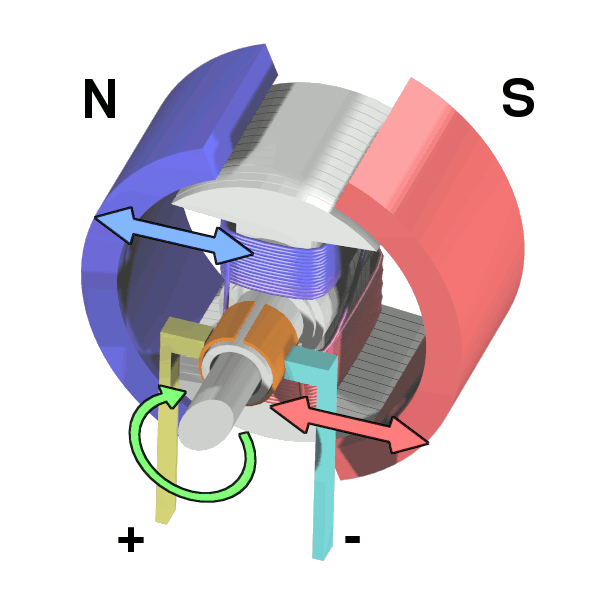
At its heart, a DC motor operates by leveraging the Lorentz force, which dictates that a current-carrying wire in a magnetic field experiences a force perpendicular to both the current and the field. In a typical brushed DC motor, this force is applied to coils wound around an armature, which is free to rotate within a stationary magnetic field (produced by permanent magnets or electromagnets called field windings). As the armature rotates, a mechanical switch known as a commutator, along with stationary brushes, reverses the direction of current in the armature coils every half-rotation. This continuous switching ensures that the torque generated by the magnetic forces always pushes the armature in the same rotational direction, enabling sustained motion. Brushless DC (BLDC) motors achieve the same result electronically, using sensors and an external controller to switch current to stator coils, eliminating the need for brushes and their associated wear and maintenance.
📊 Key Facts & Numbers
DC motors are ubiquitous, with estimates suggesting billions are in operation globally. The global DC motor market was valued at approximately $25 billion USD in 2023, with projections indicating a compound annual growth rate (CAGR) of around 4.5% through 2030. Small DC motors, often found in consumer electronics, can range from less than 1 watt to several hundred watts, while industrial-grade DC motors can exceed 10,000 horsepower (over 7.5 megawatts). The efficiency of modern DC motors, particularly brushless types, can reach upwards of 90%, a significant improvement over early designs that often struggled to surpass 70%. The demand for high-performance DC motors in electric vehicles (EVs) alone is a major driver, with the EV motor market expected to reach $50 billion by 2028.
👥 Key People & Organizations
Several key figures and organizations have shaped the DC motor's trajectory. Michael Faraday's foundational work on electromagnetism in the 1830s is paramount. William Strutt built one of the earliest functional DC motors in 1837. Zénobe Gramme's invention of a practical DC generator in the 1870s was critical for powering these motors. Later, Nikola Tesla's innovations, while more famously associated with AC motors, also contributed to a deeper understanding of electromagnetic principles. Major manufacturers like Bosch, Nidec Corporation, and Johnson Electric are leading producers of DC motors today, driving advancements in efficiency and power density for applications ranging from automotive systems to industrial automation.
🌍 Cultural Impact & Influence
DC motors have profoundly influenced the course of technological and societal development. Their ability to provide controlled rotational power was instrumental in the Second Industrial Revolution, enabling the mechanization of factories and the development of electric transportation systems like trams and early electric cars. The widespread use of DC motors in household appliances, from vacuum cleaners to electric toothbrushes, has fundamentally altered domestic life. In the realm of entertainment, DC motors power everything from remote-controlled toys to the intricate mechanisms in animatronics and robotics. The advent of the universal motor, capable of running on both AC and DC, further expanded their applicability, making portable power tools a reality for millions.
⚡ Current State & Latest Developments
The DC motor landscape is currently dominated by advancements in brushless DC (BLDC) technology, driven by demands for higher efficiency, longer lifespan, and reduced maintenance. Companies like Nidec Motor Corporation are pushing the boundaries of power density and thermal management. In the electric vehicle sector, there's a continuous race to develop lighter, more powerful, and more cost-effective DC motor designs, with innovations in materials science and advanced control algorithms playing a crucial role. Furthermore, the integration of DC motors into smart systems, enabled by IoT and AI, is leading to more sophisticated automation in manufacturing, logistics, and even personal mobility devices, with new sensor technologies and predictive maintenance algorithms becoming standard.
🤔 Controversies & Debates
Debates surrounding DC motors often center on the trade-offs between brushed and brushless designs. Brushed DC motors are simpler, cheaper to manufacture, and offer excellent torque at low speeds, making them ideal for cost-sensitive applications like toys and basic appliances. However, their brushes wear out, requiring regular maintenance and limiting their lifespan and speed. Brushless DC motors, while more complex and expensive due to the need for electronic controllers, offer superior efficiency, reliability, and speed, making them the preferred choice for high-performance applications like EVs and drones. The environmental impact of rare-earth magnets used in many high-performance BLDC motors is another point of contention, spurring research into alternative materials and recycling methods.
🔮 Future Outlook & Predictions
The future of DC motors appears increasingly intertwined with electrification and automation. Expect continued improvements in efficiency and power density, particularly for BLDC motors, driven by the relentless growth of the electric vehicle market and the expansion of robotics in manufacturing and service industries. Innovations in materials science, such as new magnetic alloys and advanced insulation techniques, will likely lead to motors that are smaller, lighter, and more robust. Furthermore, the integration of AI and machine learning into motor control systems will enable predictive maintenance, adaptive performance tuning, and even self-optimization, making DC motors even more integral to intelligent systems. The development of solid-state commutation could eventually replace traditional electronic controllers, further enhancing reliability and reducing system complexity.
💡 Practical Applications
DC motors are fundamental to a vast array of practical applications. In the automotive industry, they are indispensable for power windows, windshield wipers, electric power steering, and, most significantly, as the primary propulsion units in electric vehicles (EVs). In consumer electronics, they drive hard disk drives, CD/DVD players, printers, and electric toothbrushes. Industrial applications include conveyor belts, pumps, fans, machine tools, and robotics. In aerospace, they are used for flight control surfaces, landing gear actuation, and cabin systems. Even in everyday items like electric shavers and cordless drills, DC motors provide the necessary mechanical power, demonstrating their pervasive utility across nearly every sector of modern life.
Key Facts
- Category
- technology
- Type
- topic