
Contents
Overview
The genesis of Dungeons & Dragons can be traced back to the wargaming circles of the late 1960s and early 1970s, particularly within the midwest convention scene where Gary Gygax and Dave Arneson first met. Arneson adapted wargaming rules for a solo campaign he called 'Blackmoor,' introducing the concept of a single player controlling a single character in a fantasy setting. Gygax, already a co-founder of TSR and a designer of Chainmail, saw the potential in Arneson's innovations. Together, they refined these ideas, adding detailed rules for character creation, combat, magic, and exploration, culminating in the first commercially published version of D&D. This initial release, often referred to as 'Original Dungeons & Dragons' or OD&D, was a radical departure from its predecessors, laying the groundwork for the entire role-playing game industry.
⚙️ How It Works
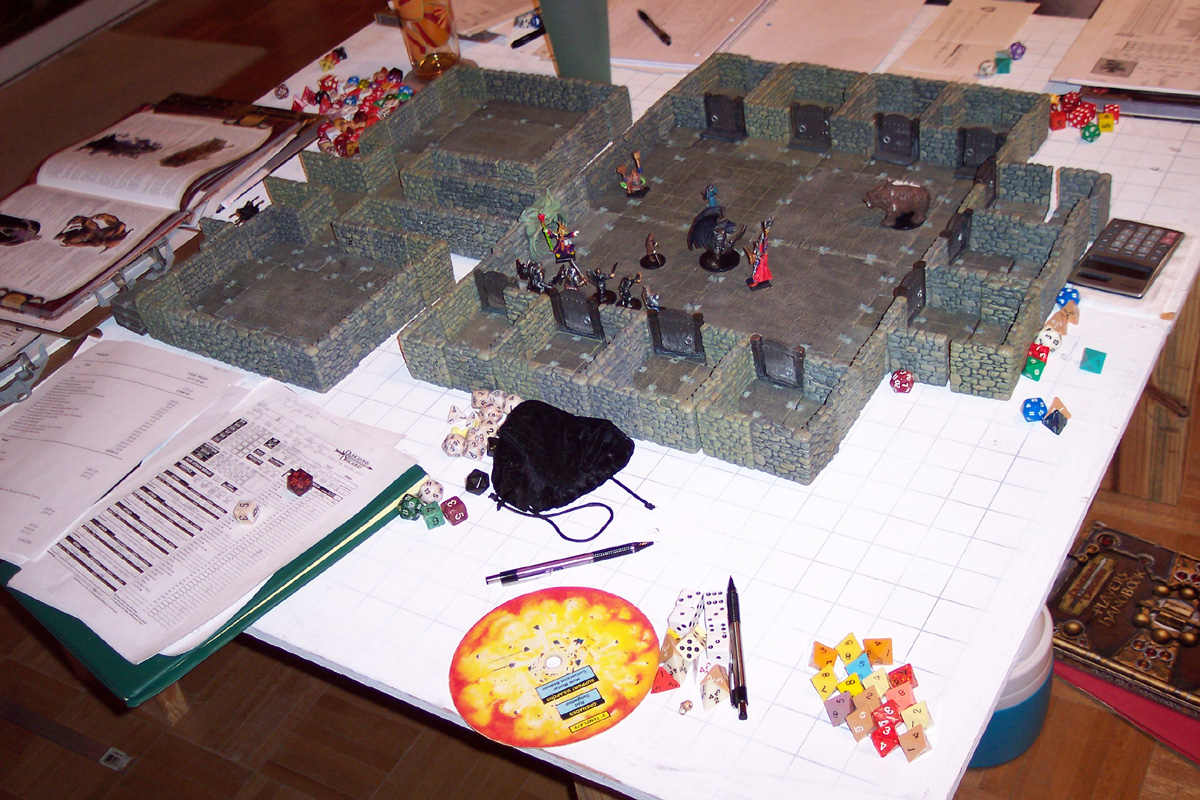
At its core, D&D is a narrative game facilitated by dice rolls and a shared imagination. One player assumes the role of the Dungeon Master (DM), who acts as the referee, storyteller, and world-builder, describing the environment, non-player characters, and challenges. The other players each control a single character, defined by a character sheet detailing their race, class, abilities (determined by ability scores like Strength, Dexterity, and Intelligence), skills, and equipment. Players describe their characters' actions, and the DM determines the outcome, often by having the player roll a twenty-sided die (d20) against a target number or 'Difficulty Class' (DC). Success or failure in these rolls, combined with strategic decision-making and role-playing, drives the narrative forward through adventures and campaigns.
📊 Key Facts & Numbers
Since its inception, D&D has seen several major revisions, with the current iteration being the fifth edition, released in 2014. The fifth edition of D&D was shaped by figures like Richard Baker, Jonathan Tweet, and Mike Mearls. The game's influence extends to over 100 countries and is translated into more than 15 languages.
👥 Key People & Organizations
The foundational figures of D&D are undoubtedly Gary Gygax and Dave Arneson, whose collaboration in the early 1970s birthed the game. Following TSR's acquisition by Wizards of the Coast in 1997, figures like Richard Baker, Jonathan Tweet, and Mike Mearls have been instrumental in shaping subsequent editions, particularly the highly successful fifth edition. Hasbro, the parent company of Wizards of the Coast, oversees the brand's strategic direction. Numerous independent game designers and publishers, such as Paizo Publishing with its Pathfinder game, have also emerged as significant players in the broader TTRPG ecosystem, often building upon or diverging from D&D's established mechanics.
🌍 Cultural Impact & Influence
Dungeons & Dragons has permeated global culture, acting as a gateway to fantasy for millions and influencing countless other media. Its narrative structures and character archetypes have been directly referenced in television shows like Stranger Things, films such as The Gamers series, and literature from R.A. Salvatore's Drizzt Do'Urden novels to the works of Neil Gaiman. The game's emphasis on collaborative storytelling and problem-solving has also been recognized for its educational benefits, fostering creativity, critical thinking, and social skills in players of all ages. The iconic imagery of dragons, dungeons, and adventurers has become synonymous with fantasy itself, solidifying D&D's status as a cultural touchstone.
⚡ Current State & Latest Developments
As of 2024, Dungeons & Dragons is experiencing a renaissance, largely driven by the fifth edition's accessibility and the explosion of online play facilitated by platforms like Roll20, Fantasy Grounds, and D&D Beyond. The release of new sourcebooks, such as 'The Book of Many Things' (2023) and the upcoming 'Planescape: Adventures in the Multiverse' (2023), continues to expand the game's lore and mechanics. Wizards of the Coast has also been actively engaging with its community, soliciting feedback for potential future rule updates and embracing digital tools to enhance the player experience. The brand's visibility has been further amplified by major media projects, including a feature film and an animated series in development.
🤔 Controversies & Debates
The game has not been without its controversies. Historically, D&D faced criticism from religious groups in the 1980s, who erroneously linked it to Satanism and occultism, a phenomenon known as the Satanic Panic. More recently, debates have arisen within the community regarding inclusivity and representation in game content, leading Wizards of the Coast to issue statements and revise certain older materials to be more welcoming. Discussions also frequently occur around game balance, the interpretation of rules, and the perceived 'gatekeeping' by some veteran players towards newcomers, highlighting the ongoing tension between tradition and evolution within the D&D community.
🔮 Future Outlook & Predictions
The future of Dungeons & Dragons appears robust, with Wizards of the Coast investing heavily in its expansion. The planned 'One D&D' initiative, a revision of the fifth edition ruleset set for release in 2024, aims to modernize the game further while maintaining backward compatibility, a move met with mixed reactions from the player base. Beyond rulebooks, the brand is expanding into digital realms with potential video games and virtual tabletop integrations, alongside continued media tie-ins. The increasing popularity of TTRPGs globally suggests a sustained growth trajectory, with D&D likely to remain at the forefront, adapting to new technologies and player expectations.
💡 Practical Applications
D&D's structured approach to problem-solving and collaborative storytelling offers numerous practical applications beyond pure entertainment. Educators utilize D&D in classrooms to teach critical thinking, math skills (through dice mechanics and probability), history (by simulating historical scenarios), and social-emotional learning, fostering teamwork and empathy. Therapists employ D&D in group settings to help individuals develop communication skills, manage anxiety, and build confidence. Furthermore, the game's emphasis on improvisation and narrative construction serves as a valuable training tool for writers, actors, and even business professionals looking to enhance their creative and interpersonal abilities.
Key Facts
- Category
- culture
- Type
- concept