
Contents
Overview
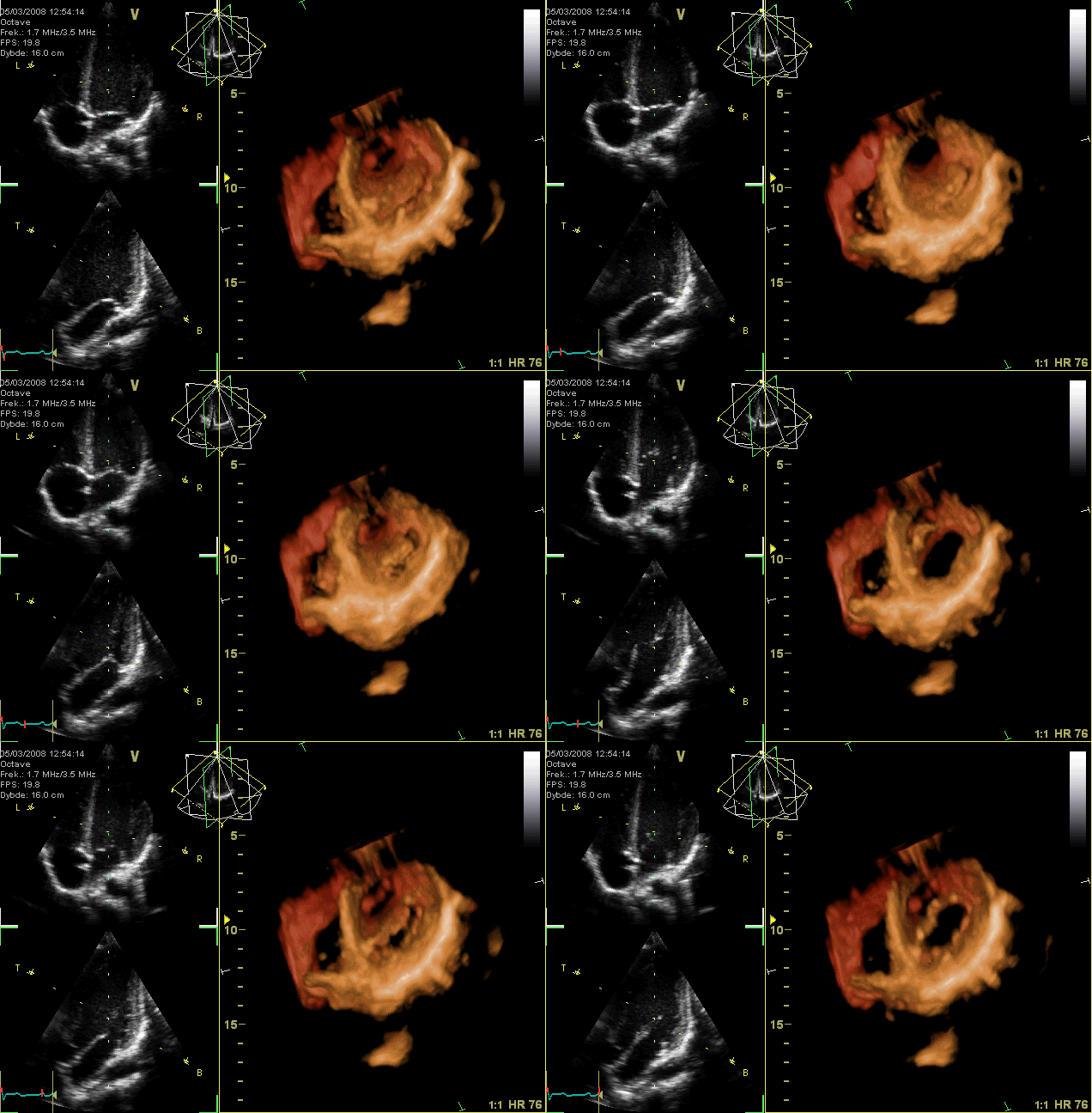
Echocardiography, commonly known as a cardiac ultrasound, is a non-invasive medical imaging technique that utilizes ultrasound waves to create detailed visual representations of the heart. This diagnostic tool, producing an 'echocardiogram' or 'echo,' is indispensable in cardiology for assessing heart structure, function, and blood flow. It quantifies chamber size, pumping efficiency (like ejection fraction), and valve integrity. Echocardiography has evolved significantly since its inception, moving from early 2D imaging to sophisticated 3D and 4D imaging, offering unprecedented insights into cardiac mechanics. Its widespread adoption underscores its critical role in diagnosing and managing a vast spectrum of cardiovascular diseases, from congenital defects to acquired conditions like valvular heart disease.
🎵 Origins & History
Echocardiography builds upon the foundational principles of ultrasound technology developed for sonar during World War II. The development of Doppler ultrasound revolutionized the field by enabling the measurement of blood flow velocity, adding a dynamic dimension to cardiac assessment. Advancements in transducer technology, digital signal processing, and imaging algorithms led to the high-resolution 2D echocardiography widely used today.
⚙️ How It Works
Echocardiography operates on the principle of ultrasound physics, where high-frequency sound waves are emitted by a transducer. These waves travel into the body, and when they encounter different tissues and interfaces within the heart, they are reflected back as echoes. The transducer then receives these returning echoes, and a sophisticated computer system processes them based on their timing and intensity to construct real-time images. Doppler echocardiography specifically analyzes the frequency shift of returning sound waves caused by moving blood cells, allowing for the visualization and quantification of blood flow direction and velocity. This dual capability of structural imaging and flow assessment is what makes echocardiography so powerful.
📊 Key Facts & Numbers
The typical cost of a standard transthoracic echocardiogram (TTE) can range from $1,000 to $3,000 before insurance. Advanced techniques like transesophageal echocardiography (TEE), which involves inserting a probe down the esophagus for clearer views, account for an additional significant volume of procedures. The accuracy of echocardiography in diagnosing conditions like mitral regurgitation can exceed 90% when performed by experienced sonographers and interpreted by skilled cardiologists.
👥 Key People & Organizations
Key figures instrumental in the development and popularization of echocardiography include Ing-vegard Edler and Georg Kossmann. Paul Siegel and Alfonso Gonzalez-Lavin were pioneers in the United States, establishing early echocardiography labs. Organizations like the American Society of Echocardiography (ASE) and the European Association of Cardiovascular Imaging (EACI) play crucial roles in setting standards, promoting research, and educating professionals. Major manufacturers of echocardiography equipment include Philips Healthcare, GE Healthcare, and Siemens Healthineers, each contributing significantly to technological advancements.
🌍 Cultural Impact & Influence
Echocardiography has profoundly reshaped the landscape of cardiovascular medicine, moving diagnoses from largely clinical and invasive methods to readily accessible, non-invasive imaging. It has become a cornerstone in medical education, with virtually all cardiology trainees expected to master its interpretation. The visual nature of echocardiograms has also made complex cardiac conditions more understandable to patients and their families, fostering better engagement in treatment plans. Its influence extends to cardiac surgery, where intraoperative TEE guides surgeons in real-time, and to interventional cardiology, aiding in procedures like TAVR and mitral valve repair. The widespread availability of portable echocardiography devices has also democratized cardiac assessment, bringing it to remote areas and bedside care.
⚡ Current State & Latest Developments
The current era of echocardiography is marked by rapid integration of artificial intelligence (AI) and machine learning (ML). AI algorithms are being developed to automate measurements, detect subtle abnormalities, and even predict cardiovascular events from echocardiographic data, potentially reducing interpretation time and improving diagnostic accuracy. 3D and 4D echocardiography are becoming more commonplace, offering volumetric data and improved spatial understanding of complex cardiac anatomy and pathology. Furthermore, advancements in contrast echocardiography are enhancing the visualization of myocardial perfusion and endocardial borders, particularly in challenging cases. The development of handheld, portable ultrasound devices, often referred to as point-of-care ultrasound (POCUS) or 'smartphone echocardiography', is expanding access to cardiac imaging at the bedside and in primary care settings.
🤔 Controversies & Debates
One persistent debate revolves around the optimal training and credentialing for echocardiographers and interpreting physicians. While the ASE and other bodies provide guidelines, variations in training rigor and experience can lead to differences in image quality and diagnostic accuracy. Another area of discussion is the appropriate use of echocardiography, with concerns about overuse in certain clinical scenarios, leading to unnecessary costs and potential for incidental findings. The integration of AI also raises questions about physician oversight, data privacy, and the potential for algorithmic bias. Furthermore, the comparative efficacy and cost-effectiveness of echocardiography versus newer modalities like cardiac MRI and cardiac CT for specific diagnostic questions remain subjects of ongoing research and clinical debate.
🔮 Future Outlook & Predictions
The future of echocardiography is inextricably linked to advancements in AI, miniaturization, and multimodal imaging integration. AI is expected to become an indispensable tool, moving beyond simple automation to providing predictive analytics and decision support. The increasing sophistication of handheld devices will likely lead to a further decentralization of cardiac imaging, making it a routine part of physical examinations in various medical specialties. Integration with other imaging modalities, such as cardiac MRI and CT angiography, will offer more comprehensive cardiovascular assessments, with AI helping to fuse and interpret data from multiple sources. We may also see the development of 'virtual' echocardiography, where AI reconstructs detailed cardiac models from limited data or even from other imaging types.
💡 Practical Applications
Echocardiography finds extensive application across numerous medical fields. In adult cardiology, it is the primary tool for diagnosing and monitoring heart failure, coronary artery disease, hypertension, and arrhythmias. In pediatric cardiology, it is crucial for identifying and managing congenital heart defects, such as atrial septal defects and ventricular septal defects. Cardiothoracic surgeons rely on it for pre-operative planning and intraoperative guidance. Critical care physicians use portable echocardiography for rapid bedside assessment of hemodynamic status and to guide interventions. It's also employed in rheumatology to assess for cardiac manifestations of autoimmune diseases an
Key Facts
- Category
- science
- Type
- topic