
Contents
- 🎵 Origins & History
- ⚙️ How It Works
- 📊 Key Facts & Numbers
- 👥 Key People & Organizations
- 🌍 Cultural Impact & Influence
- ⚡ Current State & Latest Developments
- 🤔 Controversies & Debates
- 🔮 Future Outlook & Predictions
- 💡 Practical Applications
- 📚 Related Topics & Deeper Reading
- Frequently Asked Questions
- References
- Related Topics
Overview
Future tech encompasses the spectrum of emerging innovations currently transitioning from theoretical research to scalable implementation, fundamentally altering the human experience. Unlike static historical tools, these technologies—ranging from quantum computing to CRISPR gene editing—operate on the frontier of what is physically and ethically possible. The field is defined by a high degree of uncertainty, massive capital investment from entities like Sequoia Capital and DARPA, and a relentless drive toward radical efficiency or biological enhancement. As of 2025, the focus has shifted from mere digital connectivity to the physical integration of artificial intelligence into robotics and the human body. This domain is not just about gadgets; it is a battleground for global hegemony, where the mastery of advanced semiconductors and nuclear fusion dictates the future of geopolitical power.
🎵 Origins & History
The conceptual roots of future tech trace back to the post-WWII era of cybernetics and the speculative visions of authors like Isaac Asimov. In 1945, Vannevar Bush published 'As We May Think,' predicting a device called the Memex that prefigured the modern World Wide Web. The formalization of 'Future Studies' as an academic discipline gained traction in the 1960s through the RAND Corporation, which developed the Delphi method for forecasting. By the 1990s, the focus shifted toward nanotechnology, popularized by Eric Drexler in his book 'Engines of Creation.' Today, the lineage continues through the 'accelerationist' movements and the rapid prototyping culture of Silicon Valley.
⚙️ How It Works
Future tech operates through a cycle of 'Hype Cycles' and 'Valleys of Death,' where laboratory breakthroughs must survive the transition to commercial viability. The mechanics often involve technological convergence, where fields like biotechnology and IT merge to create new capabilities like brain-computer interfaces. Engineers utilize generative design and digital twins to simulate performance before a single atom is moved. High-performance computing clusters from NVIDIA provide the raw processing power required to model complex systems like protein folding or climate patterns. This iterative process is increasingly automated, with machine learning algorithms identifying new materials and chemical compounds faster than human researchers.
📊 Key Facts & Numbers
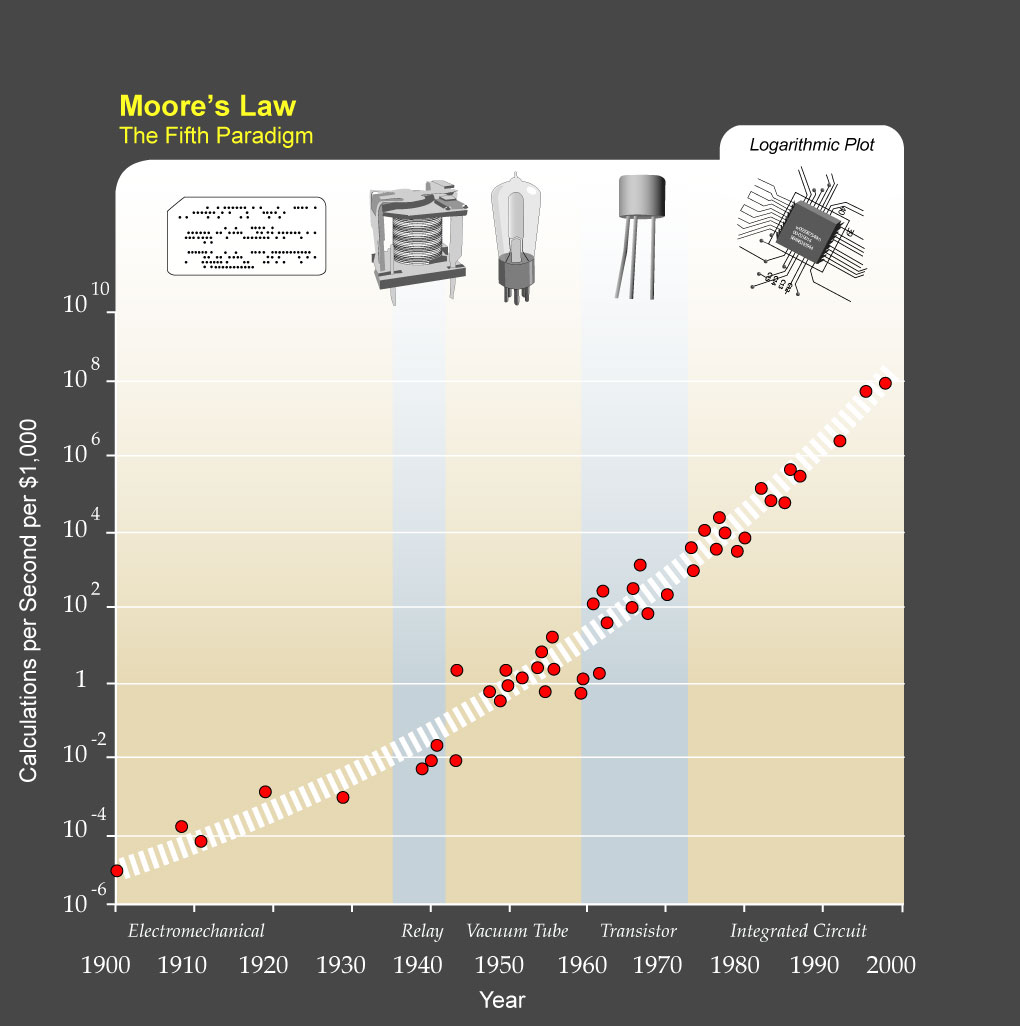
The scale of investment in future tech is staggering, with global R&D spending reaching approximately $2.5 trillion in 2023. Venture capital funding for deep tech startups grew by over 300% between 2016 and 2021, signaling a massive shift toward hard science. In the realm of quantum computing, the market is projected to exceed $100 billion by 2030, driven by players like IBM and Google. Meanwhile, the cost of sequencing a human genome has plummeted from $100 million in 2001 to under $200 in 2024, a rate faster than Moore's Law. Furthermore, the SpaceX Starship program aims to reduce the cost of reaching orbit to under $10 per kilogram, a 99% reduction from the Space Shuttle era.
👥 Key People & Organizations
The landscape is dominated by visionary founders and massive institutional players who dictate the direction of progress. Elon Musk remains a central figure through his work with Tesla, SpaceX, and Neuralink, pushing the boundaries of transport and cognition. On the institutional side, Sam Altman of OpenAI has become the face of the AGI race, while Jensen Huang of NVIDIA controls the hardware backbone of the era. Organizations like DARPA and the Chinese Academy of Sciences provide the foundational funding for high-risk, high-reward research. These entities often operate in a state of 'coopetition,' where they collaborate on standards while competing for talent and patents.
🌍 Cultural Impact & Influence
Future tech has moved from the fringes of science fiction into the core of global culture, influencing everything from aesthetics to philosophy. The cyberpunk aesthetic, once a warning of high-tech/low-life futures, has become a design reality in cities like Shenzhen and Dubai. Concepts like transhumanism—the belief that humans should use technology to evolve—have moved from niche forums to mainstream debate. Popular media, such as the series Black Mirror, reflects a growing societal anxiety regarding the unintended consequences of rapid innovation. This cultural resonance is also seen in the rise of solarpunk, an optimistic counter-movement advocating for sustainable, green-tech futures.
⚡ Current State & Latest Developments
In 2024 and 2025, the primary focus of future tech is the 'embodiment' of AI through advanced humanoid robotics. Companies like Figure AI and Boston Dynamics are deploying robots that can learn tasks through observation rather than explicit programming. In the energy sector, the ITER project and private firms like Helion Energy are hitting critical milestones in the quest for commercial nuclear fusion. The medical field is seeing the first FDA-approved treatments using CRISPR-Cas9 for sickle cell disease, marking the era of programmable medicine. Simultaneously, the deployment of LEO satellite constellations like Starlink is bringing high-speed connectivity to the most remote corners of the planet.
🤔 Controversies & Debates
The rapid pace of future tech development has sparked intense ethical and existential debates. Critics like Nick Bostrom warn of the 'alignment problem,' where an AI superintelligence might act against human interests. There is also a fierce debate over germline editing, with many arguing it could lead to a new era of eugenics and social stratification. The environmental impact of crypto mining and AI data centers has also come under fire, highlighting the tension between digital progress and ecological limits. Furthermore, the 'Right to Repair' movement, led by activists like Louis Rossmann, fights against the planned obsolescence and closed ecosystems of tech giants like Apple.
🔮 Future Outlook & Predictions
Looking toward 2030 and beyond, the integration of augmented reality into daily life via lightweight glasses is expected to replace the smartphone. Experts predict that solid-state batteries will finally solve the range and charging issues of EVs, leading to a total phase-out of internal combustion engines in many regions. The long-term horizon includes the possibility of asteroid mining for rare earth minerals, a venture currently being explored by companies like AstroForge. By 2040, the first permanent human settlements on Mars may be established, fundamentally changing our status as a single-planet species. However, these advancements will likely be shadowed by the ongoing challenge of job displacement as AI masters increasingly complex cognitive tasks.
💡 Practical Applications
Practical applications of future tech are already transforming industries from agriculture to finance. In 'smart cities' like Songdo, sensors and AI manage traffic flow and waste disposal in real-time to maximize efficiency. The finance world is being upended by DeFi and blockchain protocols that allow for trustless transactions without traditional banks. In manufacturing, additive manufacturing (3D printing) is being used to create everything from rocket engines to prosthetic limbs on demand. Even the food industry is being disrupted by cultivated meat companies like Upside Foods, which aim to produce protein without the environmental cost of traditional livestock.
Key Facts
- Year
- 2025
- Origin
- Global
- Category
- technology
- Type
- concept
Frequently Asked Questions
What is the most important future technology right now?
While subjective, most experts point to Artificial General Intelligence (AGI) as the most consequential. Unlike narrow AI, AGI would possess the ability to understand, learn, and apply knowledge across any intellectual task a human can do. Its development, led by firms like OpenAI and Google DeepMind, could accelerate every other field of science by automating the research process itself. However, this also presents the highest level of existential risk if not properly aligned with human values.
When will we have commercial nuclear fusion?
The old joke that fusion is '30 years away and always will be' is finally being challenged by new data. In 2022, the National Ignition Facility achieved a net energy gain, proving the physics works. Private companies like Commonwealth Fusion Systems are now aiming for pilot plants by the early 2030s using high-temperature superconductors. If successful, it would provide a virtually limitless source of clean energy, effectively ending the climate crisis.
How will future tech change the human body?
We are entering the era of the 'Cyborg,' where biological and synthetic systems merge. Neuralink has already begun human trials for brain implants that allow paralyzed users to control computers with their thoughts. Beyond interfaces, CRISPR technology allows for the editing of DNA to eliminate hereditary diseases or potentially enhance physical traits. This leads to the controversial concept of transhumanism, where technology is used to extend life spans and cognitive abilities beyond natural limits.
Will robots take all the jobs?
The impact of automation is expected to be a 'double-edged sword' that creates new roles while destroying old ones. A 2023 report by Goldman Sachs estimated that AI could automate the equivalent of 300 million full-time jobs globally. While manual labor has been targeted by robotics for decades, the new wave of AI targets 'white-collar' professions like law, coding, and accounting. The transition will likely require massive societal shifts, such as Universal Basic Income (UBI).
What is the 'Quantum Supremacy' and why does it matter?
Quantum supremacy refers to the point where a quantum computer can perform a calculation that is impossible for a classical supercomputer. Google claimed to reach this milestone in 2019 with its Sycamore processor. The significance lies in the ability to break current encryption standards and simulate molecular interactions for drug discovery. This has triggered a 'Quantum Race' between the United States and China, as the first to master this tech will have a massive intelligence and economic advantage.
How can I invest in future tech?
Retail investors typically gain exposure through ETFs like the ARK Innovation ETF (ARKK), which focuses on disruptive innovation. Direct investment in 'Magnificent Seven' stocks like NVIDIA, Microsoft, and Alphabet provides a stake in the infrastructure of AI. For those interested in earlier-stage tech, platforms like AngelList allow accredited investors to participate in venture capital rounds. However, future tech is notoriously volatile, with many companies failing before reaching commercial viability.
What are the biggest risks of future tech?
Beyond the 'Terminator' scenarios of rogue AI, the most immediate risks involve cyber warfare and the erosion of privacy. The rise of deepfakes and AI-driven misinformation poses a direct threat to democratic processes and social trust. There is also the risk of 'technological decoupling,' where the world splits into competing tech blocs with incompatible standards. Finally, the digital divide could widen, creating a permanent underclass that lacks access to life-extending or cognitive-enhancing technologies.