
Contents
Overview
Middle Eastern history is a sprawling, multi-millennial narrative that forms the bedrock of global civilization. It's the cradle of the first cities, the birthplace of monotheistic religions, and the crucible where empires rose and fell, shaping continents. From the dawn of agriculture in the Fertile Crescent to the complex geopolitical landscape of the 21st century, this region has been a constant nexus of innovation, conflict, and cultural exchange. Key developments include the monumental achievements of ancient Egypt, the rise and fall of empires like the Achaemenid, Roman, Umayyad, and Ottoman, and the profound impact of Judaism, Christianity, and Islam. The region's strategic location has made it a perpetual stage for trade, conquest, and the clash of civilizations, a dynamic that continues to define its present and future.
🎵 Origins & History
The story of Middle Eastern history begins not with kings and conquests, but with seeds and settlements. This agricultural surplus fueled population growth and the rise of complex societies. The invention of writing by the Sumerians, the monumental architecture of Ancient Egypt, and the sophisticated legal codes of Babylon laid foundational elements for subsequent civilizations. The region then became a battleground and melting pot for successive empires: the Achaemenid Empire, the Hellenistic world following Alexander the Great's conquests, the Roman Empire's eastern provinces, and the Sasanian Empire. This long arc of development established the region as a primary engine of human progress for millennia.
⚙️ How It Works
Middle Eastern history isn't a monolithic entity but a dynamic interplay of diverse cultures, political systems, and religious movements. Its "working mechanism" is one of constant flux, driven by factors like trade routes (the Silk Road passed through its northern reaches), resource control (oil discoveries in the 20th century), and ideological diffusion. The rise and spread of Judaism, Christianity, and Islam profoundly shaped its social and political structures, often leading to periods of both coexistence and conflict. Empires like the Umayyad Caliphate and the Abbasid Caliphate established vast administrative networks, fostering intellectual and scientific advancements during the Islamic Golden Age. Later, the Mamluk Sultanate and the Ottoman Empire dominated vast swathes, leaving indelible marks on governance, architecture, and culture. The region's history is a testament to the enduring power of ideas and the cyclical nature of power.
📊 Key Facts & Numbers
The sheer scale and antiquity of Middle Eastern history are staggering. The Fertile Crescent is a region of immense historical significance. By the Bronze Age (circa 3300–1200 BCE), sophisticated civilizations like those in Mesopotamia and Egypt boasted populations in the hundreds of thousands. The Achaemenid Empire at its peak in the 5th century BCE may have ruled over a significant portion of the world's population. The Ottoman Empire controlled territories spanning three continents for an extended period, from the late 13th century until its dissolution. In the 20th century, the discovery of vast oil reserves transformed economies, with countries like Saudi Arabia and Iran becoming major global energy producers.
👥 Key People & Organizations
Numerous figures and entities have sculpted the course of Middle Eastern history. Sargon of Akkad forged the world's first empire. Hammurabi of Babylon is renowned for his legal code. Cyrus the Great founded the Achaemenid Empire and is revered for his tolerance. Jesus Christ and Prophet Muhammad are central figures in Christianity and Islam, respectively, faiths that originated and spread from this region. Saladin is celebrated for his chivalry during the Crusades. In the modern era, Gamal Abdel Nasser championed Arab nationalism, while figures like Ayatollah Ruhollah Khomeini led the Iranian Revolution. Organizations like the Arab League and the OPEC continue to shape regional dynamics.
🌍 Cultural Impact & Influence
The Middle East's historical legacy is woven into the fabric of global culture. It gifted the world foundational inventions and concepts. The Abrahamic religions—Judaism, Christianity, and Islam—which originated here, have billions of adherents worldwide and have profoundly influenced art, philosophy, and social structures across continents. The Islamic Golden Age saw advancements in mathematics, astronomy, medicine, and optics, with scholars like Al-Khwarizmi and Ibn Sina (Avicenna) making seminal contributions. Architectural marvels like the Pyramids of Giza, the Dome of the Rock, and the Great Mosque of Cordoba showcase enduring aesthetic traditions. Modern Middle Eastern literature and cinema, exemplified by authors like Naguib Mahfouz and filmmakers from the Egyptian cinema industry, continue to offer unique perspectives on universal human experiences.
⚡ Current State & Latest Developments
The contemporary Middle East is a direct product of its tumultuous history, marked by the enduring impact of colonial borders drawn in the early 20th century, the ongoing Israeli-Palestinian conflict, and the rise of non-state actors. The aftermath of World War I saw the dissolution of the Ottoman Empire and the imposition of mandates by Britain and France, leading to the creation of many modern nation-states with artificial boundaries. The discovery and exploitation of oil in the mid-20th century dramatically altered regional power dynamics and international relations, leading to events like the 1973 oil crisis. The region remains a focal point for global energy markets and a stage for complex geopolitical rivalries, including proxy conflicts in countries like Syria and Yemen. The ongoing refugee crises and the persistent threat of extremism are stark reminders of unresolved historical grievances and political instability.
🤔 Controversies & Debates
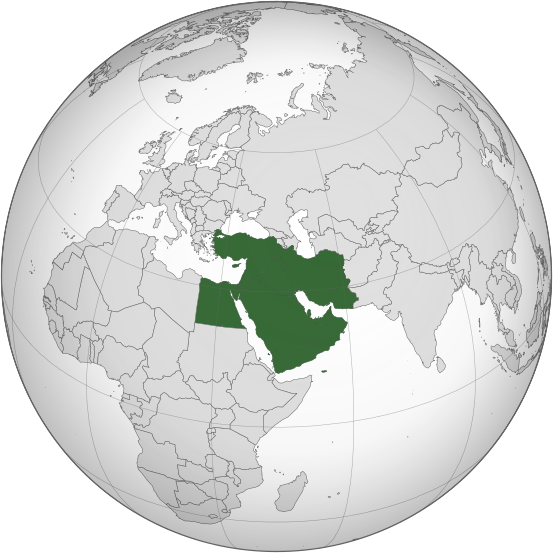
The definition of the "Middle East" itself is a historical and political construct, often debated and contested. The term "Near East" was historically used by Europeans, reflecting a Eurocentric worldview, and its boundaries have shifted over time. The inclusion or exclusion of countries like Egypt, Turkey, or Iran can vary depending on the context—historical, political, or cultural. Furthermore, the legacy of colonialism and the imposition of artificial borders by powers like Britain and France after World War I are a constant source of contention, fueling nationalist sentiments and territorial disputes. The narrative of the Israeli-Palestinian conflict is another deeply divisive issue, with vastly different historical interpretations and competing claims to land and identity. The role of external powers, from historical empires to modern global superpowers, in shaping regional destinies is also a subject of intense debate.
🔮 Future Outlook & Predictions
The future of the Middle East will undoubtedly be shaped by its past. The region faces significant challenges: managing water scarcity exacerbated by climate change, navigating the transition away from fossil fuel dependency, and addressing deep-seated socio-economic inequalities. The demographic bulge of a young population presents both an opportunity for innovation and a risk of instability if economic prospects remain dim. The ongoing competition between regional powers like Iran and Saudi Arabia, alongside the persistent threat of ex
Key Facts
- Category
- history
- Type
- topic