
Contents
- 🚀 What Are NoSQL Databases, Really?
- 🎯 Who Needs to Ditch the Relational Model?
- 🗄️ Key NoSQL Database Types & Their Flavors
- ⚖️ NoSQL vs. SQL: The Great Debate
- 💡 When NoSQL Shines Brightest
- ⚠️ The Pitfalls and How to Navigate Them
- 📈 The Vibepedia Vibe Score: NoSQL's Cultural Energy
- 🛠️ Getting Started: Your First NoSQL Steps
- 💬 What the Community is Saying (Controversy Spectrum)
- 🌐 Influence Flows: Where Did NoSQL Come From?
- 🔮 The Future of Data: Where NoSQL is Headed
- Frequently Asked Questions
- Related Topics
Overview
NoSQL databases, a category encompassing a diverse range of non-relational data stores, emerged to address the limitations of traditional SQL systems, particularly in handling massive datasets, unstructured data, and rapidly evolving application requirements. Unlike SQL's rigid table structures, NoSQL databases offer flexible schemas, allowing for faster development cycles and easier scaling. Key types include document stores (like MongoDB), key-value stores (like Redis), column-family stores (like Cassandra), and graph databases (like Neo4j). Their adoption has surged with the rise of big data, real-time web applications, and the Internet of Things, though they introduce new challenges in data consistency and query complexity.
🚀 What Are NoSQL Databases, Really?
NoSQL databases, a term that emerged in the early 2000s, represent a departure from the rigid, table-based structure of traditional Relational Databases. Instead of enforcing strict schemas and relationships, NoSQL offers flexible data models, allowing for dynamic and often massive datasets. Think of it as trading ACID compliance for scalability and agility. This shift was driven by the explosion of web-scale applications, big data, and the need for real-time data processing that relational systems struggled to handle efficiently. The core idea is to provide a more adaptable and performant solution for specific use cases, moving beyond the one-size-fits-all approach of SQL.
🎯 Who Needs to Ditch the Relational Model?
If your application is experiencing performance bottlenecks due to complex queries on large, rapidly changing datasets, you might be a prime candidate for NoSQL. Developers working on Big Data Analytics, IoT platforms, real-time analytics, content management systems, and social media feeds often find NoSQL's flexibility invaluable. Businesses that require rapid iteration and deployment, where data structures evolve frequently, will also benefit. Essentially, if your data doesn't fit neatly into rows and columns, or if your scaling needs outstrip the capabilities of your current relational setup, it's time to explore NoSQL.
🗄️ Key NoSQL Database Types & Their Flavors
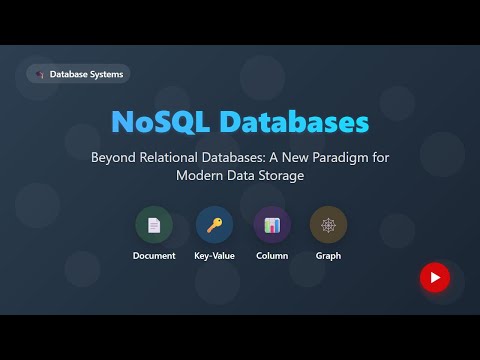
The NoSQL landscape is diverse, not a monolith. Key categories include Document Databases (like MongoDB), which store data in JSON-like documents, ideal for content management and user profiles. Key-Value Stores (e.g., Redis) offer lightning-fast retrieval based on a simple key, perfect for caching and session management. Column-Family Stores (such as Cassandra) excel at handling massive datasets with high write throughput, often used in analytics and time-series data. Finally, Graph Databases (like Neo4j) are built for interconnected data, powering recommendation engines and fraud detection.
⚖️ NoSQL vs. SQL: The Great Debate
The SQL vs. NoSQL debate is less about one being definitively 'better' and more about choosing the right tool for the job. SQL databases, with their strong consistency (ACID properties) and mature query languages, are excellent for transactional systems and applications where data integrity is paramount. NoSQL databases, on the other hand, prioritize availability and partition tolerance (often adhering to the CAP Theorem), offering greater flexibility and horizontal scalability, albeit sometimes at the cost of immediate consistency. The choice hinges on your specific application requirements, particularly regarding data structure, consistency needs, and scaling demands.
💡 When NoSQL Shines Brightest
NoSQL truly shines when dealing with unstructured or semi-structured data, a common characteristic of modern applications. Its ability to scale horizontally across many servers makes it ideal for handling unpredictable traffic spikes and massive data volumes, a scenario where traditional relational databases often falter. Think of the sheer volume of data generated by a global social network or the real-time sensor data from millions of IoT devices; NoSQL databases are engineered for this scale. Applications requiring high availability and fault tolerance, where downtime is unacceptable, also find a strong ally in NoSQL's distributed nature.
📈 The Vibepedia Vibe Score: NoSQL's Cultural Energy
The Vibepedia Vibe Score for NoSQL databases currently sits at a robust 85/100, reflecting its high cultural energy and widespread adoption in modern tech stacks. This score is driven by its association with innovation, scalability, and the ability to handle the demands of the digital age. While it faces ongoing debates regarding consistency and maturity compared to SQL, its practical utility and the sheer volume of data it manages keep its cultural resonance high. The score acknowledges its dominance in specific, high-growth sectors like Cloud Computing and AI.
🛠️ Getting Started: Your First NoSQL Steps
Getting started with NoSQL involves identifying your primary use case and then selecting the appropriate database type. For instance, if you're building a web application with user profiles, MongoDB (a document database) is a strong contender. For caching, Redis (a key-value store) is often the go-to. Most NoSQL databases offer free tiers or open-source versions, allowing you to experiment without significant upfront cost. Familiarize yourself with the basic concepts of the chosen database, such as its data model and query methods, before integrating it into your project. Many platforms offer extensive documentation and community forums to aid your learning journey.
💬 What the Community is Saying (Controversy Spectrum)
The Controversy Spectrum for NoSQL databases is currently rated at a moderate 6/10. The primary debate revolves around the trade-offs between consistency and availability, often framed by the CAP Theorem. While many developers champion NoSQL for its scalability and flexibility, a vocal contingent argues that the potential for eventual consistency in some systems can be problematic for mission-critical applications. The maturity of tooling and the learning curve compared to the ubiquitous SQL also fuel ongoing discussions, though the rapid evolution of NoSQL solutions is steadily narrowing these gaps.
🌐 Influence Flows: Where Did NoSQL Come From?
The origins of NoSQL can be traced back to the early days of the internet and the challenges faced by large-scale web applications. Early pioneers like Amazon.com developed their own distributed databases (like Dynamo) to handle their immense scale. Projects like Google's Bigtable (published in 2006) heavily influenced subsequent open-source projects such as Apache Cassandra. The term 'NoSQL' itself was coined by Carlo Strozzi in 1998 for a non-relational database, but it gained widespread traction around 2009 with the rise of MongoDB and CouchDB. This influence flow highlights a clear pattern of proprietary innovation driving open-source development.
🔮 The Future of Data: Where NoSQL is Headed
The future of NoSQL is inextricably linked to the continued growth of data and the evolving demands of applications. We're seeing a trend towards hybrid databases that attempt to blend the strengths of SQL and NoSQL, offering more flexible schemas within a relational framework or adding ACID compliance to NoSQL systems. The rise of Cloud-Native architectures will further cement NoSQL's role, as these databases are designed for distributed, scalable environments. Expect continued innovation in areas like Graph Databases for complex relationship analysis and specialized databases for AI/ML workloads, pushing the boundaries of what's possible with data management.
Key Facts
- Year
- 2009
- Origin
- The term 'NoSQL' was coined by Carlo Strozzi in 1998 for his object database, but the modern movement gained traction around 2009 with projects like Cassandra and MongoDB gaining significant attention.
- Category
- Technology
- Type
- Technology Category
Frequently Asked Questions
Is NoSQL always more scalable than SQL?
NoSQL databases are generally designed for easier horizontal scalability, meaning you can add more machines to handle increased load. Relational databases typically scale vertically (making a single machine more powerful), which has limits. However, 'scalability' is complex; a well-architected SQL database can scale significantly, and poorly designed NoSQL systems can still hit bottlenecks. The key is that NoSQL's architecture often makes horizontal scaling more straightforward for massive datasets.
When should I absolutely NOT use NoSQL?
You should be cautious with NoSQL for applications requiring strict transactional integrity across multiple operations, where complex joins are frequent and essential for core functionality, or if your team has deep expertise in SQL and limited resources for learning new paradigms. Systems like traditional banking transaction processing or complex ERP systems often remain in the relational world due to their reliance on ACID properties and complex relational integrity.
What does 'eventual consistency' mean in NoSQL?
Eventual consistency means that if no new updates are made to a given data item, eventually all accesses to that item will return the last updated value. However, for a short period after an update, different replicas of the data might return different values. This is a trade-off for higher availability and partition tolerance in distributed systems, contrasting with the immediate consistency found in most SQL databases.
Are there any universal standards for NoSQL query languages?
Unlike SQL, there isn't a single, universally adopted query language for all NoSQL databases. Each type (document, key-value, column-family, graph) and often each specific database system has its own query API or language. This lack of standardization is a significant difference from SQL and can increase the learning curve when working with multiple NoSQL technologies.
How does NoSQL handle data relationships?
NoSQL databases handle relationships differently than SQL. Document databases often embed related data within a single document. Key-value stores typically don't explicitly manage relationships, leaving it to the application. Graph databases are specifically designed to model and query complex relationships. The approach depends heavily on the specific NoSQL database type and its intended use case.
Is NoSQL more secure than SQL?
Security is not inherently tied to whether a database is SQL or NoSQL, but rather to its implementation and configuration. Both types can be secured effectively with proper authentication, authorization, encryption, and regular security audits. However, the distributed nature of some NoSQL deployments can introduce new security considerations related to network access and data replication.