
Contents
- 🎵 Origins & History
- ⚙️ How It Works
- 📊 Key Facts & Numbers
- 👥 Key People & Organizations
- 🌍 Cultural Impact & Influence
- ⚡ Current State & Latest Developments
- 🤔 Controversies & Debates
- 🔮 Future Outlook & Predictions
- 💡 Practical Applications
- 📚 Related Topics & Deeper Reading
- Frequently Asked Questions
- References
- Related Topics
Overview
The genesis of Warhammer 40,000 can be traced back to the burgeoning popularity of tabletop wargaming in the early 1980s, particularly Games Workshop's own Warhammer Fantasy Battle. Conceived by Rick Priestley and Ian McCombie, the first edition, Warhammer 40,000: Rogue Trader, was released in September 1987. This initial iteration was a more open-ended, role-playing-infused experience, emphasizing exploration and individual characters within a grim, futuristic setting. Subsequent editions, notably the second edition in 1993, began to solidify the game's core mechanics and lore, introducing iconic factions like the Space Marines and the Orks with greater prominence. The game's universe, characterized by its extreme grimdark aesthetic and perpetual conflict, was further fleshed out through a massive output of novels by authors such as Dan Abnett and Graham McNeill under the Black Library imprint, transforming it from a niche wargame into a cultural phenomenon.
⚙️ How It Works
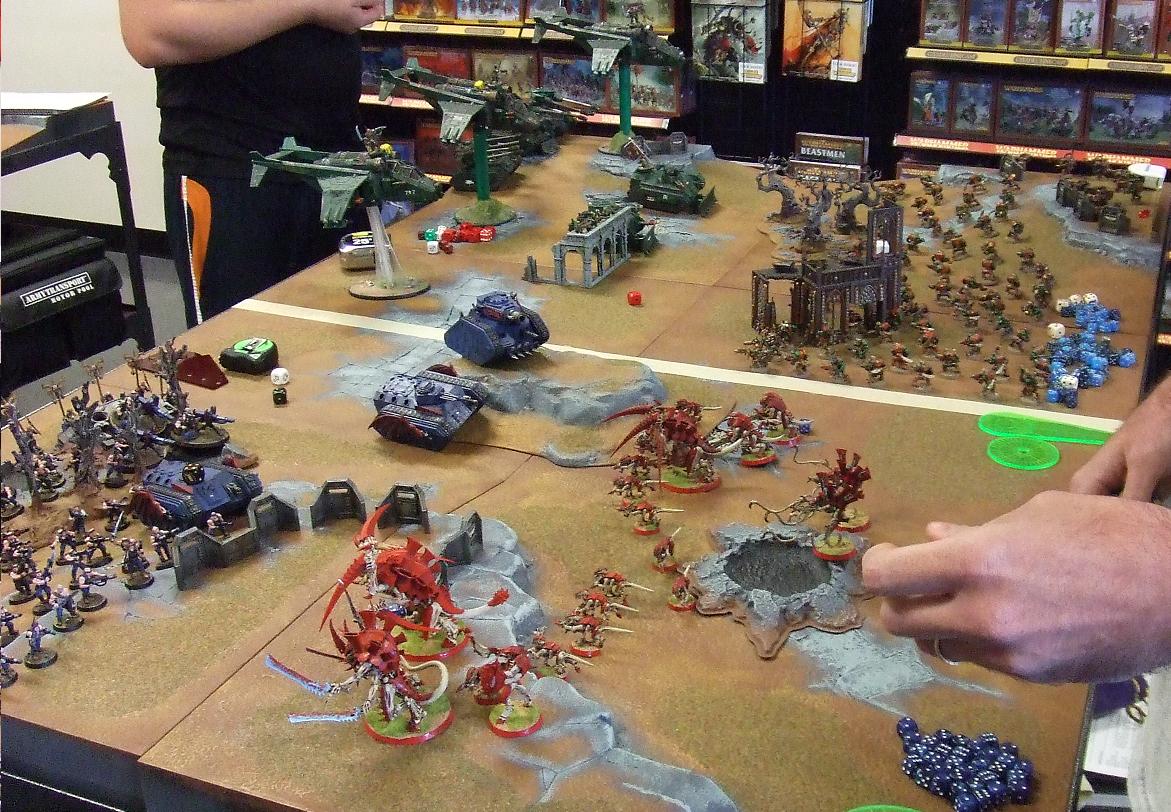
At its core, Warhammer 40,000 is a tactical wargame played on a tabletop representing a battlefield, typically measuring 4x6 feet. Players select armies composed of miniature figures, ranging from individual heroes to hulking war machines, each with unique stats and abilities detailed in codexes and rulebooks. Turns are divided into phases: movement, psychic powers, shooting, and melee combat. Movement is dictated by the unit's speed stat and terrain features, while combat is resolved using polyhedral dice, primarily six-sided dice (d6), against target numbers determined by unit statistics and modifiers. The game's complexity lies in army composition, strategic deployment, resource management (like command points), and understanding the intricate interactions between different unit types and faction abilities, a system that has been refined through ten distinct editions since its inception in 1987.
📊 Key Facts & Numbers
The Warhammer 40,000 universe is vast, with its lore spanning over 10,000 years of fictional history. Games Workshop produces over 1,000 unique miniature models for the game, with an estimated 500,000 players actively participating worldwide. The global market for miniature wargames, heavily dominated by WH40K, is valued at over $1 billion annually. The tenth edition, released in June 2023, saw an unprecedented surge in pre-orders, with initial production runs selling out within hours. The Black Library imprint publishes over 50 new novels annually, selling millions of copies, and the associated video game market generated an estimated $300 million in revenue in 2023 alone, demonstrating the franchise's immense commercial scale.
👥 Key People & Organizations
The intellectual property and production of Warhammer 40,000 are solely managed by Games Workshop, a British company founded in 1975. Key figures instrumental in shaping the game's lore and mechanics include Rick Priestley, often credited as the primary creator of the 40K universe, and Andy Chambers, who played a significant role in developing the lore and rules for several editions. Numerous authors, such as Dan Abnett, Graham McNeill, and Aaron Dembski-Bowden, have contributed extensively to the Black Library's vast literary output, building the rich narrative tapestry. The game's visual identity has been heavily influenced by artists like John Blanche, whose distinctive gothic and baroque art style defined the grimdark aesthetic for decades.
🌍 Cultural Impact & Influence
Warhammer 40,000's influence extends far beyond the tabletop, permeating popular culture and inspiring countless other media. Its distinctive 'grimdark' aesthetic, a blend of gothic horror, brutalist architecture, and extreme militarism, has become a recognizable shorthand for dystopian science fiction. The franchise has spawned a successful line of video games, including the critically acclaimed Dawn of War series and the narrative-driven Ciaphas Cain novels, which have introduced millions to its lore. Furthermore, the game's thematic elements of religious fanaticism, xenophobia, and existential dread have been cited in academic discussions on political science and sociology, reflecting its resonance with contemporary anxieties. The upcoming live-action series produced by Henry Cavill signals a significant push into mainstream entertainment.
⚡ Current State & Latest Developments
As of 2024, Warhammer 40,000 is in its tenth edition, released in June 2023, which introduced significant rule changes aimed at streamlining gameplay and enhancing accessibility. Games Workshop has continued its aggressive release schedule, launching new model kits for factions like the Adeptus Mechanicus and the Tyranids throughout 2023 and early 2024. The company also announced a major partnership with Amazon Studios to develop a live-action Warhammer 40,000 television series, with Henry Cavill attached as an executive producer and potential star, a move generating immense excitement and speculation within the fanbase. This expansion into high-budget television marks a pivotal moment for the franchise's mainstream visibility.
🤔 Controversies & Debates
The most persistent controversy surrounding Warhammer 40,000 revolves around Games Workshop's pricing and release strategies, often criticized by segments of the player base as being exploitative or designed to encourage constant purchasing of new models and rulebooks. Debates also frequently erupt within the community regarding the lore's direction, with some fans lamenting perceived narrative stagnation or the over-centralization of certain factions, particularly the Space Marines. The use of AI-generated art in some promotional materials, as seen in discussions around Owlbear AI, has also sparked debate within the broader creative community, raising questions about artistic integrity and the future of illustration in the hobby.
🔮 Future Outlook & Predictions
The future of Warhammer 40,000 appears poised for significant expansion, driven by the aforementioned Amazon Studios partnership and Henry Cavill's involvement. Analysts predict this could lead to a substantial increase in the franchise's global brand recognition and player base, potentially rivaling established IPs like Star Wars. Games Workshop is also investing heavily in digital platforms and augmented reality experiences to complement the physical game, hinting at a future where the lines between tabletop and digital gaming blur further. Continued focus on narrative depth and faction diversity, alongside potential new game systems, will be crucial for maintaining long-term engagement with its dedicated fanbase.
💡 Practical Applications
While primarily a tabletop wargame, the principles and aesthetics of Warhammer 40,000 have found applications in various fields. The detailed miniature painting and modeling aspects have fostered a thriving hobbyist community, with techniques and tools developed for WH40K painting influencing broader model-making and artistic disciplines. The game's complex strategic elements have been studied in academic contexts, particularly in game theory and military history simulations, offering insights into tactical decision-making and logistical challenges. Furthermore, the franchise's extensive lore and world-building have served as inspiration for independent game developers and writers, demonstrating its impact as a creative wellspring beyond its direct commercial products.
Key Facts
- Year
- 1987
- Origin
- United Kingdom
- Category
- culture
- Type
- platform
Frequently Asked Questions
What is Warhammer 40,000?
Warhammer 40,000 is a tabletop miniature wargame set in a dystopian science-fiction universe created by Games Workshop. Players command armies of miniatures, engaging in tactical battles across a tabletop battlefield. The game is renowned for its 'grimdark' aesthetic, depicting a galaxy locked in perpetual, brutal warfare against alien species and supernatural horrors. It was first released in 1987 and has since evolved through ten editions, becoming the world's most popular miniature wargame.
What does 'grimdark' mean in the context of Warhammer 40,000?
'Grimdark' is an aesthetic and thematic descriptor for Warhammer 40,000 that signifies a universe characterized by extreme darkness, brutality, and a lack of hope. It portrays a future where humanity is constantly at war, facing overwhelming odds from alien empires, daemonic incursions, and internal corruption. Moral ambiguity is rampant, heroism is often futile, and suffering is a constant. This bleak outlook, heavily influenced by artists like John Blanche, permeates the lore, artwork, and gameplay, distinguishing it from more optimistic science-fiction settings.
How many factions are there in Warhammer 40,000?
The Warhammer 40,000 universe features a vast array of distinct factions, broadly categorized into the Imperium of Man (including Space Marines, Astra Militarum, Adeptus Mechanicus, etc.), the forces of Chaos, and various alien races such as the Orks, Aeldari, Tyranids, Necrons, and T'au Empire. Each faction possesses unique lore, miniatures, and gameplay mechanics, offering players a wide variety of strategic choices and thematic experiences.
What is the significance of the Horus Heresy?
The Horus Heresy is the pivotal event in the Warhammer 40,000 timeline, occurring roughly 10,000 years before the game's primary setting. It details the galaxy-spanning civil war where the Emperor of Mankind's most favored son, Warmaster Horus, was corrupted by the forces of Chaos and led half of the Space Marine Legions in rebellion against the Imperium. This cataclysmic conflict shattered the nascent human empire, led to the Emperor's mortal wounding and internment on the Golden Throne, and fundamentally shaped the oppressive, stagnant Imperium that exists in the 41st millennium.
Is Warhammer 40,000 just a game, or is there more to it?
While Warhammer 40,000 began as a tabletop miniature wargame, it has evolved into a massive multimedia franchise. Its extensive lore is explored through hundreds of novels published by Black Library, numerous video games across various genres, animated series, and now a major live-action television series in development with Amazon Studios and Henry Cavill. The hobby itself encompasses miniature painting, modeling, and community engagement, making it a significant cultural phenomenon with a dedicated global following.
How do I get started playing Warhammer 40,000?
Getting started with Warhammer 40,000 typically involves purchasing a starter set, such as the Leviathan set for the tenth edition, which includes miniatures, dice, and basic rules. Alternatively, players can choose a small combat patrol box for their preferred faction. It's recommended to visit a local Games Workshop store or independent retailer for advice, and to watch introductory painting and gameplay tutorials on platforms like YouTube. Building and painting miniatures is a core part of the hobby, and many players find it as rewarding as the game itself.
What are the future plans for Warhammer 40,000?
The future of Warhammer 40,000 looks expansive. Games Workshop is committed to ongoing development of the tenth edition rules and lore, with regular releases of new models and codexes for all factions. The most significant development is the Amazon Studios partnership for a live-action series, which promises to bring the grimdark universe to a much wider audience. Further integration of digital tools and potentially augmented reality experiences are also anticipated, alongside continued expansion of the Black Library's literary universe.